Showing posts with label Kanha. Show all posts

Monday, April 3, 2023

Tiger Safari at Kanha National Park in India


Kanha National Park is one of the most popular parks in India and receives over 100,000 domestic and overseas visitors. It is a tiger reserve and a National Park. The park is a conservation unit focused on saving the big cats, the ecosystem, and other life forms.

Although the park is for the conservation of critically endangered tigers its major success has come from the conservation of the Barasingha or the hard-ground swamp deer. From 66 heads to more than 500 heads the success was remarkable. George Schaller and the team played a crucial role in saving the species. The campaign was carried out in the late sixties and seventies. 

Kanha National Park

Situated in Central India near Jabalpur Airport the park is home to over 100 tigers and other wild animals. Some of the major fauna that inhabits the park are:

Tiger

Leopard

Swamp Deer

Sloth Bear

Bison

Axis Deer

Barking Deer

Mouse Dear (Rare)

Jackal

The mouse deer was seen and photographed after a gap of 14 years. It was thought to be extinct but the re-discovery was a big surprise. Small and nocturnal animals are the porcupine, civet cats, and foxes.

There are more than 250 avian species that include Palearctic migrants that arrive in the winter. Some of the popular species are Malabar Pied Hornbill, Shama, Racket Tailed Drongo, Spangled Drongo, Alexandrine Parakeet, and Orange Headed Rock Thrush.

Safari at Kanha 

The park is divided into four zones in the core area that comprises 940 sq. km. They are;

Kisli Zone

Kanha Zone

Sarhi Zone

Mukki Zone

The area of each zone is roughly 25 sq. km and each offers wonderful sightings of wild animals. Tigers are seen in every zone while Kanha and Mukki are the favorites for big cat sightings. The birds are all over the place. The tourism area has also been carved out in the buffer zone that comprises 1000 sq. Km.

Khatia (Kisli Gate)

Khapa (Mukki Gate

Phen (Micro Core)

Sijora (Sarhi Gate)

The excursions are possible on safari permits and there is a limit to park entry of vehicles. You should thus book the tiger safari in advance.  You can book a safari online at MPOnline Portal and also book at the respective gates. But it is better to book online since entry permits get sold out fast.   


Saturday, January 21, 2023

 Tiger Safari at Kanha National Park

Kanha National Park is a tiger reserve situated in Central India in the State of Madhya Pradesh.  It is one of the oldest parks and received conservation status as early as the 19th Century. The Halon and Banjar Valleys were closed for hunting during the British Raj, and thus this was a conservation initiative.

Tiger Family

In post-independent India, the area was declared a National Park in the year 1955.  Then it was notified as a tiger reserve in the year 1973, under the Project Tiger Program. In the year 2000, it was awarded as the most tourism-friendly park in India. Kanha is also recognized as the best-managed tiger reserve in India with high-profile VVIPs visiting every year.

Kanha National Park Conservation Profile

Kanha National Park comprises an area of over two thousand sq. km with 940 sq. km as the core. The core is a protected area that is inviolate and managed by the forest department. It is where the tigers and other wild animals breed the most.         

Tigress with Cub 

The park is home to over 100 tigers and the critically endangered hard ground Barasingha or the Swamp Deer (Cervus duavcelli branderi). It is also known as the Branderi Barasingha who first noticed the hardened hooves that evolved in absence of swamps to enable the deer to move on hard ground.  This was impacted by the changing geography of the region which was once a large crater full of marshy swamps.  The park is well known for saving the Barasingha from extinction by raising the population from just 67 heads to more than 500 at present.   

Over 150 guard huts are built to safeguard wildlife in the park with beat guards regularly patrolling the reserve.

Kanha National Park Tiger Safari

Tiger tourism as it is called is carried out in 20% of the core. It is divided into four zones:

  • ·         Kanha Zone
  • ·         Kisli Zone
  • ·         Mukki Zone
  • ·         Sarhi Zone

Each zone is reserved for safari for those with the permit. At Kanha, permit holders cannot trespass into another zone. This is possible only on a full-day safari which is priced much higher.  Tigers breed in each zone without any hindrance and offer an opportunity for tourists to see them in their natural surroundings. Though habitats may be diverse, the park provides each with a tiger safari permit an equal chance to track and chance upon the big cats.   


Besides other animals, tourists can see plenty of birds more so in winter when Pale Arctic migrants arrive. There are over 250 species of avian in the park.

Tiger safaris are organized in the buffer as well. They are cheaper, and without many restrictions but offer a little chance to sight the big cats.

These are:

  • ·         Phen
  • ·         Khatia
  • ·         Sijhora
  • ·         Khapa

If you do not book a tiger safari in advance the permits get exhausted. Your only chance is to visit the buffer zone or stay at the resort. Hence always book the tourism zones in the core in advance. Please make all the preparation for the tiger safari in India in advance.   

Thursday, May 18, 2017

Interview: Mr.Sanjay Shukla Park Director Kanha National Park

Interview: Mr. Sanjay Shukla - Field Director Kanha National Park in Madhya Pradesh. Interesting answers on questions posed by Last Wilderness Organization based in India

Sunday, January 8, 2017

Tigress in Our Backyard

Courtyard House Kanha

Guests Simon & Toby + Family...The USA. 


Fifteen minutes after we left Courtyard House at the buffer zone of Kanha National Park there was a tumultuous uproar. Monkeys, chital, and sambar got busy ringing the bell. Alarm cries started ringing all over. The staff, alert as ever could quickly make out a predator's presence. 

From the intensity of the call, there was little to doubt that it was a leopard or a tiger. The calls continued as the predator crossed over our grounds a little distance from the fence and vanished into the dense canopy that surrounds Courtyard House.   

Ever inquisitive the guard went to inspect and discovered pug marks of a tigress. That was it a tigress in our backyard. A few days earlier we had heard a commotion in the late evening over a leopard ambushing a sambar fawn which it managed to kill. The next day its remains were found near the water body about hundred yards from Courtyard House.  

The guests came across a tiger at the entrance of the park near Khatia Gate hence all was well. The next day we saw Munna the tiger which dominated the region before the huge Karai Ghati male stepped in.
Tiger Photo Uday Patel 
 

Tuesday, June 23, 2015

A Kill in Making

Leopard Safari at Kanha National Park 

It was one of those days when you have a tough time deciphering calls. We were on a tiger safari in the Sarhi Zone whence we reached the Saunf Meadow. We had just crossed over the Siliyari Waterbody and were moving further. At the Saunf meadow, we encountered frantic calls of the langur.   

The monkey was up on the tree facing towards the road to Sarhi. The calls continued for a very long time aided by other langurs now and then. But we could see and hear nothing...the alarm was strong and continuous.  We waited in expectation for a long time and looked all over near and far but no big cat was in sight.

Normally frantic calls mean a moving cat which also means a sure-shot sighting. Well almost! The guide had lost all hope and urged us to proceed in order to maintain timings.

"We will return via this road while turning back", I said to the guide. "Worth investigating", he affirmed. So we continued through the magic landscape of  Sarhi Zone inundated by the mesmerizing Sulkum River. 

After an hour or so on the return, we slowed down and searched. The calls had ceased, but anyway we were proceeding slowly since the area Saunf Meadow is often visited by the tigers. Two safari jeeps passed us nodding their head in disappointment which meant nothing exciting behind.     

It was going to be a dull day I thought as we continued.

Well, not. "Stop," shouted the guide.

Move back he instructed the driver much to the amazement of my foreign guests staying at Courtyard House Kanha. For there sprawled on the rock was a full-grown leopard in bright sunlight looking straight at us. WoW!

I looked back to see if the jeeps were still near us but they had sped away on their way. The leopard...shy predator? No way he sat on the rock sprawled like a cool cat. After some time he moved toward the ground and stretched.   

He then sat down majestically and looked at us menacingly disturbed perhaps by our presence at such close quarters. Then much to our surprise, he began to move in the grass barely visible at times. It was amazing how the big cat could perfectly camouflage and easily loose itself  amidst the short crop grass. 
Leopard in Grass - Credit Teerath Singh

The game of hide and seek continued as the leopard moved toward a pair of spotted deer. Totally unaware of death at close quarters they continued to graze merrily on the edge of the jungle road. Another jeep had joined us with loads of noisy holidaymakers.

We are going to witness a rare hunt, a moment of our lifetime. Feeling highly excited we were barely able to contain our tongues. The brilliance of the acrobatic grace of the creature had us totally mesmerized. Cameras clicking was all that made the sound. 

The graceful cat would crouch and then move forward excruciatingly slow. I could see the path it chose all the time keeping it in hiding. What a drama I whispered to the guests.  

The hunt was perfectly on the leopard had crouched to about ten feet from the unaware deer.  And then! Woof!

From the other side of the road, a noisy Bolera jeep belonging to the forest department came towards us approached the deer, and manage to scare them away. The game was over. The abject disregard for what was happening was nothing new. With due respect for the conservation efforts, many times the forest staff is disregardful and rude towards the tourists and totally unmindful of their activities.       

The vehicle sped past at good speed disturbing the hunt and a hungry leopard who vanished from sight.  

Many times I think mannerism is important and the chauvinistic attitude towards tourism becomes evident in the tiger reserves. Proper behavioral code is as important for the tourists as it is for the departmental staff. I have noticed this lacuna on many occasions regarding the latter.  

Friday, May 15, 2015

Dinesh Makhija - Wildlife Photography

Swamp Deer

Swamp Deer Herd

Swamp Deer Pair

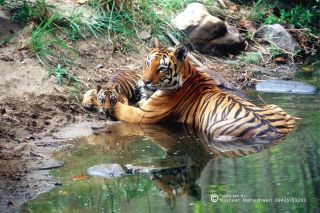
Tiger in Water

Tiger By Night

Tiger Portrait

Barasingha
Barasingha Family

Bengal Tiger

Tiger

Gaur
Enjoy the spectacular images of wilderness at Kanha. The photography by Dinesh Makhija requires not have many words to describe the magnificent animals of Kanha National Park in Madhya Pradesh. Mr. Makhija owns a budget lodge near the game park at Khatia Gate.    


Wednesday, February 11, 2015

Activities at Kanha

Kanha is not just a place for watching wildlife it is also for living it up. Here are some images that will entice you to visit the tiger reserve in order to have a fun
Cooking is Fun

Kanha Wilderness

Resort Guests

Cooking on Fire

General's Visit

General's Medal

Generals Gaurd

Cooking Lesson

Courtyard House

Guests Entertainment

Cooking On Kanda Fire

Tea Time

General

Yoga

Yoga
filled holiday.

Saturday, January 17, 2015

Kuch Nahi - He! He!

For many years I have discovered that there is a lighter side to life even if the going is tough. On tiger safari whence you are not able to come across or detect big cats the picture is gloomy... absolutely gloomy. On one side there is the tourist sitting with a mug expression and on the other side, your reputation as a wildlife guide is at a stake. The driver who budges in as an expert in trekking whence opportunity strikes makes it very clear that he is only a man behind the wheel. The forest guide can be very good at dozing whence going gets tough. 

All the braggadocio at Courtyard House at last night's bonfire over booze now hangs over. Eh! Eh!  With every passing jeep, there arrives a possibility of bright light. 

Kyon Bhai Kya? (Anything)

Kuch Nahi! (Nothing)

Call at Nakti Ghati!

Kuch Nahi!

We proceed further and arrive at pug marks. Stale. Night Over! There goes another Kuch Nahi! He!He!        
Another Jeep Arrives! 

Kyon Bhai? Kuch Dikha! 

A bunch load of tired tourists groggy-eyed over last night's excesses peek at you in expectation. Some of them look more like deflated marriage invitees returning home after free fun rather than the smartly attired adventure seekers that move around with long lenses hanging loose.      

Kuch Nahi! He! He!

Aage Check Karte Hein? Hauow!

Did they see the tiger the guests ask? 

"No! None Have Seen." What a relief. We are all in the same boat. Whew!     
Courtyard House At Kanha

Crested Serpent Eagle on the dead tree. Seeeeeeeee! There are no takers.

A female was sighted at Karai Ghati! What! Not our area I tell the guests. Fish not biting. Tigers are not moving near the road I inform the guest. No alarm cries. No pug marks.  "Oh yes we can make that out", the guests affirm politely.   
Young Tiger by Yves Blisson

Kuch Nahi! I inform the eager staff at our hotel. "Will see one in the evening round", I assure you. Well, Kuch Nahi but yes tiger safari is cheese only if you know how to make one rather the just cheesing ooF! Chasing tigers.    

Wednesday, December 31, 2014

Wild Dog at Kanha

Last season I saw a lone dhole or wild dog at Kanha Ghat and then near Indri Road. In my subsequent visits this animal was not sighted my be nor reported by anyone. Wild Dog are secondary carnivores and an important functionary of our jungle ecosystems.    

Being pack hunters they are generally found in pack of 12 to 14 sometimes larger. Hence the sight of single animal was a cause of worry. I was told that there was a pair that had probably stayed put for mating and breeding. 
Dhole Image by Dharmagiri
But the pack is always together, so was there a tragedy. A deadly disease could wipe of large populations of wild animals. This could have happened to wild dogs of Kanha. Last I heard of them was of their being seen on the Banzar River bridge on the way to Courtyard House on the Baihar Road.    

This year I sighted six dholes in the Mukki Zone the sight was exhilarating but I was expecting greater numbers. We missed sightings of wild dogs recently near Shravan Tal at Kanha Zone. I have no idea as of the moment of the population of this wild canid, hope it is stable. Being diurnal predators they are known to migrate locally.      

Sunday, November 30, 2014

Imprints: A Tiger on The Stroll

Kanha National Park - MP - India  

I could sense the excitement as we awaited the arrival of the General and his entourage at Kisli Rest House. The alarm cries were emanating from Karai Ghati Road. We were assigned the Kanha Zone and I thought it would be a good idea to explore the Dig Dola passageway that leads to Karai Ghati.  

The General and his family arrived and the jeep began to move. As we reached the Dig Dola Road alarm cries from the valley on the left signaled the presence of the tiger. Assuming that the tiger had already climbed uphill we proceeded toward Dig Dola. 
The General At Courtyard House Kanha

No sooner had we proceeded a few yards we came across fresh pug marks. "Tiger moving ahead," I whispered to the guide. We continued to move further along the side of the pug marks. From the placement of the imprints, I could make out that the big cat is on a leisurely stroll.   

The General and his family had never seen a tiger in the wild. "There it is," the guide whispered, needless to point out the big cat was right in the middle of the road, a bit surprised by the intrusion. Cameras began clicking as the tiger moved on the road.

A big male tiger, I could make out that it was Kankata. The tiger was on a recce and as it moved it squirted pheromones along the track on the bamboo leaves. I was observing the imprints as the animal trudged ahead. 

The tiger's movement is known as a digitigrade movement since it walks on its digit. The actual foot pad is way high up on the hind legs up to where the fifth toe is. Using this incredible appendage the animal moves absolutely silently amidst the dense forests and grasslands.     

Much to our delight, the big cat trudged along the Dig Dola Road for quite some time. On the way, he came across imprints of a tigress and began to scent. We hoped to see the tiger meeting the tigress but if wishes were tigers I would roar. 

After some time the tiger moved into the dense thickets and we proceeded to Kanha Meadow. Their wish fulfilled the General and his entourage sat down to replenish themselves with a hearty breakfast.      

Thursday, November 7, 2013

Searching for tigers during the festival of lights

We trudge slowly avoiding as many as we can but the inevitable happens more than we accept. It is about ten at the night and we are negotiating the treacherous road to the World famed National Park - Kanha.  My friends had arrived from the UK via Agra and then Varanasi for this tiger tour.

"Tired," I ask them as they alight from the train. "Not really," the lady replies. I like her spirit. We head straight to dinner at the owner's place in Jabalpur. We were to lodge at Courtyard House in Kanha. We reach the National Park around midnight and quietly slip into our rooms.  

This is my second trip to Kanha and we have come across the tiger only once. As we head for the morning drive I am quite apprehensive. This year it had rained till quite late and water is everywhere in the park, the prayer base is also scattered. This is an easy time for tigers and they are not moving. The safari is anyway livened up by the birds and other enchanting animals of the park. The couple is disappointed - Clas and Helen. Both reside in Scotland hence some information gathering for me. This is Diwali time and they are quite inquisitive about the festival of lights. "Quiet Colorful and Joyous," they remark. "Yep," I give a dull reply, my mind is occupied with possible tiger movements. Last year we sighted tigers on all our trips.


On the last day, we miss a leopard by a few minutes and then come across a tiger in the grassland. The tigress is lying about fifty yards from us in the patch of grass near Shravan Taal. We wait with bated breath but to no avail. The tigress remained for what seemed like an eternity.

"Time Up," whispers the guide. Sad and disappointed we move back to the gate. Next time I wish them luck in their journey onwards. After a day of rest, our next guest arrives from Dubai. "Two Indians, Six Swedes, and a lady from the UK. One car from Jabalpur arrives in time the rest lag behind. We have a quick lunch and then head for the Khatia Gate. We wait for an hour before the other guests arrive and load on the safari jeep.                   

Quiet late I think but then I should chance upon Munna who awaits the jeeps and then makes his move. This is a huge tiger and we drive over Sal Ghat. This jungle road leads to Kanha Meadow and is a mixed as well as Sal forest. Bamboo too is abundant here, especially on the hills. 

After driving for about twenty minutes we dash straight into Munna. This is a huge tiger well over two hundred kilos. The tiger rules over the territory of Sal Ghat, Digdola, and Kari Talia. But the beast is so powerful it transcends into other territories with brazen impunity.    

Back and forth the jeep scatters in grip of frenzy. There is panic as the seven-year-old tiger rolls along the Sal Ghat Road like a massive ball of fur oblivious of humans on the contraption. Cameras click on the shaky jeeps. My Guest Dag and Annund manage a lot of images as we scamper here and there to avoid being trampled over by the tiger.

The next day my guests sight a sloth bear with two cubs on Kanha Ghat. Bison, Swamp Deer, Wild Boar, Spotted Deer, Barking Deer, Langur, and Jackal along with very many pretty birds make up for our trip.

The guests are happy and immersed in the hospitality at Courtyard House. This fantastic Kanha Resort accommodation offers sumptuous food. This is the best Indian cuisine in the park prepared by trained chefs. The place offers luxurious comforts and spacious living experiences in private, picturesque settings.         

Thursday, October 24, 2013

A tiger died!

It is said that "Nero Fiddled While Rome Burnt". That is what, precisely, is happening with our tigers and wild animals. The whole focus is on tourism which is there for ages with no visible negative impact on the wilderness. The ministry and management spend more time on nuances of tiger safari rules and regulations than the patrolling and security of the park and its magical wildlife.

A tiger died in the corridors of Kanha National Park. It is suspected that the tiger was poisoned. The big cat roamed between the sanctuary of the tiger reserve and the periphery of villages. The question of poaching cannot be ruled out. As in the case of Panna and Sariska danger looms large on this tiger reserve. The nexus between some forest staff and organized mafia cannot be ruled out. Hence extra vigil is always on the cards. 

The male tiger was in its prime and was often sighted by tourists on a tiger safari in Kanha National Park. Two-spotted deer and a panther have also been found dead. How the endangered animals died will take a lot of time to know.  The viscera will go to many departments for the postmortem to be completed.

Getting to the root cause of the death of rare animals is a tardy process with clinical and analytic facilities available in a few places.


Tiger - Teerath Singh
Now a tiger less will make a difference since there are a few left in India. The census at Kanha Tiger Reserve will take place in January 2014. If conducted properly we will get an idea of tiger numbers in the park. The participants include volunteers. The registration form can be had from the Field Director's Office in Mandla City in MP.       

Wednesday, October 23, 2013

Joy And Despair

Come October and all the tiger reserves in MP are abuzz with activities. In Central Indian Reserves the tiger safari starts on the 16th of October every year. The tiger safari in the beginning of the season is a new experience.  

This is the toughest season for tiger watching in India. Fresh from monsoon torrents the vegetation is rich and the canopy dense. There is water available everywhere besides plenty of prey spread all around. This is the least stressful time for the Bengal tigers in the country. With no need to make a forced move, big cat sighting is scarce. Many tourists go back disappointed since on many game rounds the tiger is not seen. 

The sightings in MP are further limited by the division of tourism area, timings, and limited routes. Unlike earlier whence you could move around with will you cannot do so now. The jeep has to move in a particular direction and within the area specified. Well, this is in order to cause less disturbance to the animals but I believe the regulations could be relaxed a bit since the vehicle numbers have already been limited. 

On a recent tiger safari at Kanha we were hampered by these factors and my guests could not see the big cat. Most of the tigers start to move at dusk which is the time for the jeeps to exit the park. The morning safari pays much more dividends due to reasonable time. After a couple of failed game drives, we came across pug marks of a tigress at Sal Ghat Hill. The tigress was moving downhill and we stopped at the point where we deduced that she would move across the fireline. 

The shrill alarm cries of the bison herd ascertained the presence of the tigress. Assured that we have made the right decision we waited. Then with the increase in alarm cries, we could sense the movement. The tigress came close to us but remained hidden in the canopy. 

By now we could hear her soft roars close to us. I cherish these moments when I hear the roar of the tigers. The sound can best be described as ethereal. This was exciting and unnerving as we waited with bated breath for her to come out. The excitement ran largely on the face of my guest a lady from the UK. But the hope and excitement turned into despair whence the tigress did not emerge and went further downhill.         

"So close yet so far!" I whispered to my guest who was visibly disappointed. "Well we had a close encounter," I tried to pacify her. "Quiet an experience," I tried to get the point home. But it was not to be for she wanted to see one. She had come from far just to see the tiger and I could not fulfill her wish. The consecutive drives were devoid of tiger sightings but we came across many wild animals that are as exciting to watch. The two guests who joined us from the UK had already seen the tiger so birds and mammals enthralled them. 
 
Courtyard House Kanha
But yeah dil mange more..that's
the story of the tiger!           


Tuesday, January 17, 2012

Return of the Wild Dog

The kill was large and about ten wild dogs were at it. How they managed to kill a large cattle is not a big surprise knowing the nature of this amazing canid. The wild dog in India is known as Dhole in Hindi and has other vernacular names.

During the sixties, the number had gone down severely as it had a bounty on its head. In Kanha National Park they were killed in order to reduce Cheetal fawn predation. I have been visiting Kanha since the seventies and in recent times the dhole is being seen frequently at Kisli, Kanha, and Mukki Zone.

This is one dog that does not bark, it communicates through whistles with other members of the pack.  The nature of its predation makes it a local migratory creature. For they surprise the deer, chase it, and consume often on the run itself. With such open and shut hunting the area is soon devoid of prey. The animals' presence also unnerves the tigers and other predators.

Changing places accords greater opportunity to hunt albeit I have seen dhole stay for a longer time in high prey density areas. The wild dog is encountered in the buffer zone as well. The incident that I have described took place near the Kanha Village Eco Resort at Boda Chappri. Incidentally, this is were I came across a leopard kill earlier.  

The trans-migratory nature makes it difficult to understand the population dynamics of this creature. The pack can inhabit any good forest patch near rural settlements in Madhya Pradesh. 

Monday, January 16, 2012

More Tigers at Kanha

Navneet Bhai businessman and wildlife photographer owns Kanha Village Eco Resort based on responsible tourism.

He reports.

"Sightings of Tiger at Sarhi and Kisli zones at Kanha are really good and expected to go up with almost 23 cubs at Kanha"

Tigress and cub by Mr. Navneet Maheswari
This is fantastic news if tigers breed well in protected areas there is hope for posterity.

Saturday, July 3, 2010

Relocation: Kanha Villages

The center of attraction Kanha Tiger Reserves was once an integral part of Kanha preserve. Due to the requirement of inviolate space for endangered species and to reduce biotic pressure, relocation of villages became imperative.

The spaces for agricultural land, livestock grazing pressure, and firewood collection all were taking a heavy toll on the ecosystem. A badly shrunk and degraded ecosystem, could not afford such biotic pressure and destructive practices. The presence of human habitation was endangering wildlife. The animals like tigers and swamp deer were most affected since the latter was totally dependent upon swampy grasslands which were severely encroached.  

Most of the tribes in Kanha are Baigas, Gonds, and others of various denominations. The relocation created lots of resentment among some. Apart from compensation, the villagers benefit from joining the mainstream and eco-development programs.

Responsible Tourism has been the largest beneficiary of Vis a Vis employment and development in terms of skills and abilities. The remote settlements inside the habitation did not yield such bounties.     

The tribal to this date are able to practice their customary rites and rituals besides ingraining mainstream benefits like better education and health care facilities and ample job opportunities. 

The biggest benefit has arisen from the forest department which employs a large number of local guides and laborers. The administration has employed many tribal administrative tasks as well. Its eco-development program has benefited local communities.

The increasing number of eco-resorts in Kanha National Park and hotels follow responsible practices. A large number of locals are employed in hotels in the periphery. The responsible tourism guidelines favor employment for local communities. These tribal communities have been part of heritage sites for centuries.  

Where ever proper compensatory schemes have been introduced the local communities in protected areas have benefited.  The State government is taking all positive steps to increase inviolate areas in Kanha. There are lots of programs that seek to benefit the poor and downtrodden.

The tourism industry too should take an active interest in responsible practice which will be a big step forward in conserving this heritage wealth. 

Sunday, September 28, 2008

Tiger Safaris in October

In the early days of tourism at Central Indian tiger reserves the park opened up in November for tiger safaris this offered much-needed rest and peace to wildlife and the park authorities had the time to re-establish road infrastructure etc.

All that has changed now. Tiger tourism is at its peak and the tourist rush is considerable. So the park now opens in October a month earlier than before. Why?

Well! Tourism. Yes!

And the hotels at National Parks wish to capitalize on tourist inflow to the optimum best. They managed to convince the park management that since the breeding season o most of the wildlife gets over by this time it is okay to commence tiger safaris earlier.

Since Kanha is the largest and most popular National Park the owners of wildlife resorts at Kanha are the most active in matters relating to park safaris and tourism.

In October the monsoon rains have come to an end and with their departure humidity and wetness have been replaced by sunny weather and a bit of comforting cold. Inside the park, the flora is at its optimum density, and visibility is limited to a few paces. Hence tiger trekking is difficult but nevertheless, tigers are seen albeit at higher odds. So a minimum three-night stay is advised to the tourists.

During October and early November, the parks are at their picturesque best attired in green all over. This is the time when the weather too is at its best. So it is a happy time for tourists on tiger safari at Kanha National Park, Pench, and Bandhavgarh National Parks.

In anticipation, booking is done months in advance and especially during the Diwali holidays. This is the time when the rush is at its greatest.

Wednesday, July 16, 2008

End of the season

With the start of the monsoon, the park closes to tourists. Every year the park closes down on 3oth June and re-opens on 16th October this year. This gives much rest and privacy to the wild animals of the park.

But one negative aspect of the absence of tourists is that the park becomes more susceptible to poaching another reason for this is the turbulent rains which make traversing many areas of the park difficult even for the elephant patrol. The whole staff including the guides are involved in safeguarding the park and protecting the animals from marauding poachers. It is hard work for the park staff to look after the wild animals and forests. This is a true conservation effort and the staff should be rewarded by tourists and all for this if nothing more.

The activities in hotels in Kanha, Bandhavgarh, Pench, and other Indian tiger reserves comes to an end. It is time for rest for the hotel staff and the managers much needed. Servicing the guests is a difficult task what with most of the resources being fetched from major towns.

The timings for the staff are very tough during the season. They have to get up as early as 3.3 am in the bitter cold after having gone to sleep around 11pm. The immediate task is to prepare breakfast and tea which is offered as a packed brunch too. The visitors are woken up for the park safari after this so that they leave for the gate in time. The whole day is spent doing numerous chores and serving the guests. Most of the staff goes to sleep late and gets up very early with limited rest.

It is very disappointing when some ungrateful guests do not tip them.

Eco-tourism is not only fun and excitement watching rare and endangered species like the tiger. It is responsible tourism as well so all activities that encourage the locals and those involved will go long way in saving our precious natural inheritance.

Sunday, July 6, 2008

Welcome to a Wildlife Resort

Ever since I started frequenting Kanha as a naturalist guide, I developed a habit to account all things interesting at this wonderful National Park in India.

The last trip was a few days before the Kanha gates closed for the monsoon. Monsoons are a period of heavy rains in most parts of India including Kanha National Park.

Once you become a Kanha fan it beckons you, again and again, such is the magic of this nature preserve. Not only the tigers, but the paradise also has so much to offer.

On my last visit, I happened to visit a luxury resort at Mocha - a few kilometers from park gates - in order to take a measure of new accommodations that have been established in recent times.

The Celebration Van Vilas Resort in a true sense defines the word "luxury". Yes, the Kanha Resort is a three-star resort set amidst the lush green ambiance of Kanha. It has been designed to cater to upper-class tourists who wish for luxury yet do not wish to sacrifice the feel of the wilderness and tradition.

As a premium three-star jungle lodge Celebration keeps its promise. It delivers luxury and comfort and yet mingles perfectly with the surroundings of Kanha's pristine forests. In spite of being a luxury lodge meant for high-profile tourists from India and Abroad it retains India's rustic charm and warmth.

No wonder the owners are age-old conservationists and wildlife lovers and hence their experience of forest life speaks quite loud in their venture at Kanha. The resort justifies its surroundings and adds to the natural beauty of the forests. The wide expanse of the property with a large number of cottages dressed in ethnic splendor and a cool pool invites wildlife lovers with open arms. The hotel spells class and justifies it with its superb architecture, exquisite decor, and dotting service and cuisine which never fail to impress. Yet the resort is a prime example of responsible tourism.

  • The resort has all the must-haves of true old-time hunting lodges - a lofty machan (hide) for bird watching and catching sight of the elusive panther who patrols the jungle treks in the night as a sentinel of the wild. He often drops in to say Hello to the guests...Well almost.


  • Naturalist guides with years of experience who regale you with enchanting encounters in the wild with tigers and other mammals. The interactive well-equipped lecture hall is where one should lend ear to detailed lectures on Kanha and Indian wildlife. One should also spend free time with the nature guides here for interpretative dialog on the amazing biodiversity - flora, and fauna of Kanha.

  • The well-stocked library lets you step deep into the realms of the wilderness, hunting, and wild animals of India, penned by top naturalist guides, wildlife biologists, and writers. Else watch a movie about nature and wildlife in the auditorium.
I rate Celebration as the best place to stay in luxury at Kanha. It cannot be outdone in organizing luxury wildlife safari in the park as well. Celebration Van Vilas is simply the best.