Showing posts with label tigress. Show all posts

Wednesday, October 6, 2021

Tigress Mundi Dadar Hunts Down a Fawn

It was one of those great mornings, and we were cruising along link seven road at Kanha National Park in Central India. Margeret Norah and her husband from France were with me hoping to see their first tiger. Link Seven drive is one of the most picturesque in the tourism zone of the park. 

The road is situated at the last leg of the tourism zone in Kanha Range neighboring some forest-clad ranges, a group of tabletop mountains that form a ridge in this erstwhile crater we call Kanha National Park in Maikal Hills of Satpura Mountain Range. The Satpura Range transects Madhya Pradesh giving rise to some of most exotic terrains in the World loaded with amazing natural formations. These fantastic biodiversity heavens are also known as Tigerland. 

It was Capt. James Forsyth a geologist in British India who has best described hilly regions of Central India in his book "Highlands of Central Indian".     

That morning we had decided to cut off from the crowd which always heads towards areas where the probability of tiger sightings is the highest. And as happened for much of a distance we did not encounter any big cat nor an exciting sight of creatures that dominate the wilderness. We were heading towards the Kanha Meadow and then we had planned to visit the recreation center a place to visit the toilet and then have breakfast on the jeep bonnet in the open.  Jungle drives without any impactful sightings can be boring and silence often prevails. That was what was going on in our minds not knowing that will witness a sight of a lifetime.         

It was at Badi Gansh or Tall Grass that we encountered the tigress Mundi Dadar at that time she was dominating the link 7 area and probably had cubs.  All we could see was her head popping out of the thick grass. We had come to a stop and were keenly observing her whence I noticed here avid glance in the direction of a deer herd far away. She was repeating the act well hidden in the bush.  

"She is planning to hunt", I whispered confidently to my guests. And then we changed our plans to visit the center and decided to wait. The guests were cooperative, and an expectancy in the air loomed over us. After some time, the deer began to inch closer to the meadow and the tigress decided to come out in the open and then she quickly receded into the back of the bush. She was completely hidden now.  We could not see her. By this time two more jeeps that had just arrived, they could not see her either.  The guides of Kanha are smart people, and they knew instantly that we had located a tiger. They parked the jeep behind us and sat quietly.  

                                                          Tigeress Hunting Fawn

Unfortunately for them a spotted deer female and her fawn were strolling down the road that connects  Kanha Meadow grazing frequently as they came towards us. Our hearts had begun to beat faster in expectancy by this time. And as we had hoped for...the deer and the buck veered around and went straight to the spot where the tigress was hiding.   This is it, I said to myself and readied my mobile phone camera, Margeret had her camera rolled out in expectancy too. 

There was a big rush shrill and alarm cry as the tigress charged. Completely surprised the female dived into the nearby bush. All we could see was the big cat chasing the desperate bewildered fawn. The fawn ran in our direction with the cat chasing behind. Very close to the jeep perhaps at a distance of 10 feet, the tigress pounced on the fawn as it let out a heart rendering cry. That was it. I stood in a trance as the big cat turned in the opposite direction and scampered away with the dead baby hanging between her canines. I was close to death standing on the stationery jeep well exposed. She could have chosen me instead of the fawn. But tigers are disciplined predators and they kill only for food and we humans are not included.     

The video enumerates the last scene well but is of poor quality having filmed using a small mobile phone. 

============================================================
Uday Freelances as Naturalist in Central India. He is an avid birder and tiger enthusiast. He blogs on tigers, wildlife and birds. He also writes on the environment and conservation.

Uday also provides SEO Services and Website Contents in English. He teaches Digital Marketing in Jabalpur in Summer Holidays.
--------
Contact: pateluday90@hotmail.com
09755089323 
====================================================  

Thursday, June 28, 2018

Populating Tigers in Satkoshia Gorge in Odisha

Satkoshia Gorge is a tiger reserve that has an extensive spread of almost seven miles of the gorge as reported. Thus the name Saat stands for 7 Kosh stands for miles. It is in the Angul District of Odisha. 

The reserve has recent sightings of two females as per the reports. In order to populate tigers at Satkoshia an ambitious program has been chalked out, and good to know that it is an interstate program.

Well MP Government has sent one male tiger to the reserve and the translocation has been successful. The project was carried out under the aegis of Mr. Sanjay Shukla the present field director of Kanha Tiger Reserve in Central India.   

The program is to trans-locate six tigers of which one has already taken place. Another translocation was carried out under FD Mr. Mridul Pathak from Bandhavgarh. Here are some photographs of the events at Kanha  & Bandhavgarh Tiger Reserves. 

Repopulating Tigers 

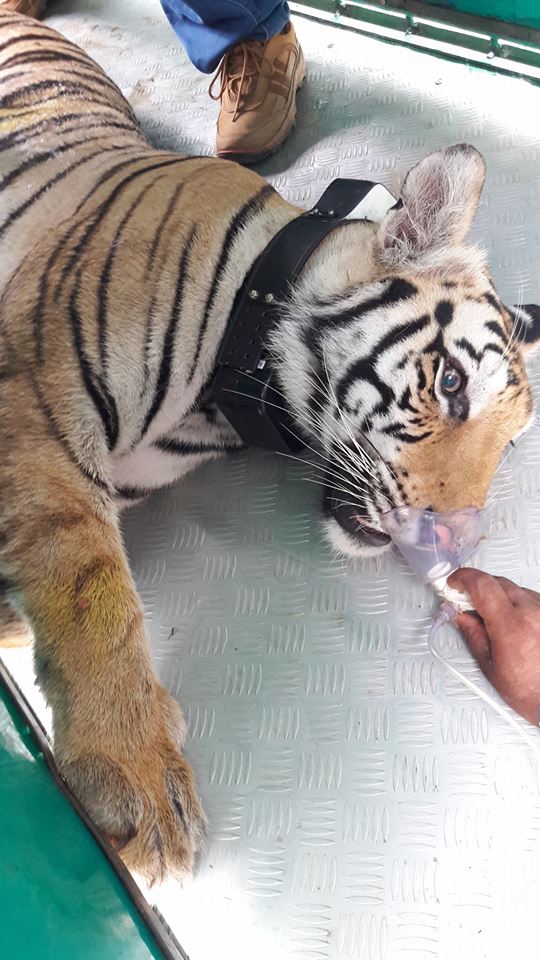
With the use of modern translocation techniques and tranquilizing methods, the exercise has become safer and a good number of trans-locations have been carried out in India.   

This has been hailed as a good conservation management adaptation. But then the fear is of wanton projects that could undermine the populations of resident tigers. Another fear is a disturbance to breeding and family structure at the place of residence. Thankfully this has not happened because planned efforts are being made to conserve this critically endangered species in India. 

Repopulating tigers usually results in balancing populations in a given habitat in a reserve. This results in the mitigation of territorial fights which often leads to fatality as has been witnessed at Mukki Zone in Kanha recently.

In a given area, the presence of even one dominant male keeps the breeding cycle going without friction between contesting males. The space between takeover by other males is time-stretched allowing the dominant male to complete a life cycle. This is also applicable to tigresses.

Population dynamics are studied carefully and an imbalance in male to female ratio is also a consideration. The presence of cubs and the sire is also taken into consideration. It is a long-drawn exercise and requires extensive planning. Another good that has taken place is that life forms have escaped the vicious net of parochialism as has been seen in the case of Asiatic Lion translocation from Gir in Gujarat.                   
Teams at Satkoshia 

Collaring

Darted Male

Elephants rounding up

ReleaseatEnclosure

Team Kanha 

Shifting

In the enclosure at Satkoshia
Team BTR
Tigress BTR
Transportation 
Collared Tigress BTR
Team at BTR 
Tigress Being Tranquilized BTR

In the truck


 Tigress Bandhavgarh


|


Monday, June 5, 2017

Tiger Safari Videos - India


Tiger safari video - Tigress at Link 8 Kanha National Park


Massive Male Tiger at Waterhole - Kanha National Park - Kisli Zone


 Legendary Munna Male Tiger at Kanha National Park in India


Early Morning Encounter Tigeress at Kanha National Park

Thursday, May 18, 2017

Searching For Tigers

My First Tiger Sighting


With trepidation, my heart thumping madly I got on to the howdah tied on the back of the elephant. The contraption made of thin steel rods and a wooden plank was nowhere near to the assurance I needed on my first jungle adventure.   

I was at Kanha National Park sometime back in the early seventies. We were on the way to see a tiger. The ride on the pachyderm was anything but comfortable as it trudged past bushes and grass in the rugged terrain. I had a tough time tackling bamboo clumps that brushed past us like sharp-edged swords. The elephant, huge as they come was in intense conversation with the mahout oblivious of us on its torturous back. 

Tigress - Uday Patel

As a young lad, I had been introduced to forests quite early. My family was in bidi business and every year there was a visit to Central Indian Jungles in order to purchase tendu leaves.   

This was my first ride on an elephant and quite an unnerving experience it was. The mahuat pointed out to a big cat painted yellow black and white sitting beside a shallow water body in bright sunlight.   “Tigress,” he called out and then went silent. I could feel the fear rising higher within me. The cat sat listlessly and did not even bother to look at us. 

So this was the much-touted tiger, the King of the jungle. A terrible roar and a charge were what I was expecting from a huge animal. They did not arrive. Mankiller, bloodthirsty, ferocious all deadly notions started to flood my mind. But the nonchalance and the ease with which the tigress sat amidst the humans grouped around her changed by views. She was at peace with herself and her surroundings. This set to ease trepidation within me and my notions about this magnificent predator changed dramatically. Over the years I came to understand the tiger as part of an ecosystem that was connected to the environment upon which we all depend. That day I had become a tiger lover.   

My brother clicked from his simple black and white camera. The photo was a proud possession and it decorated the walls for a number of years.          


Friday, April 14, 2017

Tigress Early Morning Stroll - Video

The Story
Kanha National Park 
Tigersess on stroll  
Guest Pauline & Kath UK
Courtyard House  


We tracked this tigress from where it was likely to be. Tiger frequent a spot or place after a gap of few days in order to catch the prey unaware.

Beautiful early morning with cool breeze flowing all over. It was an enthralling moment in the pristine wilderness of Kanha. Partially hidden among strands of grass we spotted the angelic tigress.  


Our guests were thrilled beyond words. The cameras began to click as we reversed the jeep up to a safe distance. The tigress arose from the foliage and came unto the road. Then the stroll began, oblivious of us she began to walk towards us and we kept backing. This continued for a long time and I used my mobile to film her. 

After what seemed like eternity the another jeep arrived much to their delight they too could witness the ethereal moment. She would step into the near by bush and spray hormones an essential act of scent marking for communication.  

Tigers can charge badly, and you would not want to witness the event. Hence we kept a safe distance all the time. Eventually other jeeps arrived and the big cat moved deeper into the bush and vanished. 

Saturday, January 21, 2017

Tiger Conservation: Tigress Electrocuted

Another One Down. 

This time near the Sidhi Tiger Reserve in Central India. The tigress met with a torturous end after being electrocuted by electric lines. She was in care of three cubs which may as well die. This is absolute tragedy.

The Deadly Lines

The eleven KVA lines work across the whole nation, but they are misused near the tiger reserves. Even humans, and poachers (sic) have died, the latter entrapped in their own evil mechanism. The menace poses a serious threat and should be curtailed by all means.

The related incidences have occurred at Pench, Kanha, Bandhavgarh and now Sidhi. They might be occurring elsewhere without fail.  The incidences have occurred with a degree of regularity. I believe a solution was provided by an NGO...covered wires to be used near the reserve, but they are rotting in the store.    

Until unless we do not consider all elements of tiger conservation seriously,saving the critically endangered species will be an arduous task. The these incidence continue to happen, and are miserable. They speak of  volumes of how seriously we take conservation of carnivores in India. 

This is not end since we lose predators, wild elephants and other animals to railway tracks and highways as well. This is also a regular occurrence.

These death raise serious questions especially whence these have been occurring since decades in India. Surprisingly no solutions have been found or are we not bothered at all?

We do not wish to see the back of this one. IC Teerath Singh
Why do we not impose speed limits to an extent the accidents are avoided?

Do these issue appear to be non glamorous to our wildlife managers and policy makers?

Is there a serious thought accorded to these issues? Well it does not seem so!    

At present juncture we cannot afford to lose a single tiger or a leopard. Same applies to all life forms without prejudice. A comprehensive policy should be framed for conserving critically endangered species, taking into consideration all elements that pose a threat to their survival.

More Tiger Deaths By Electrocution

Sunday, January 8, 2017

Tigress in Our Backyard

Courtyard House Kanha

Guests Simon & Toby + Family...The USA. 


Fifteen minutes after we left Courtyard House at the buffer zone of Kanha National Park there was a tumultuous uproar. Monkeys, chital, and sambar got busy ringing the bell. Alarm cries started ringing all over. The staff, alert as ever could quickly make out a predator's presence. 

From the intensity of the call, there was little to doubt that it was a leopard or a tiger. The calls continued as the predator crossed over our grounds a little distance from the fence and vanished into the dense canopy that surrounds Courtyard House.   

Ever inquisitive the guard went to inspect and discovered pug marks of a tigress. That was it a tigress in our backyard. A few days earlier we had heard a commotion in the late evening over a leopard ambushing a sambar fawn which it managed to kill. The next day its remains were found near the water body about hundred yards from Courtyard House.  

The guests came across a tiger at the entrance of the park near Khatia Gate hence all was well. The next day we saw Munna the tiger which dominated the region before the huge Karai Ghati male stepped in.
Tiger Photo Uday Patel 
 

Saturday, July 2, 2016

Tiger Conservation - Successful Breeding - Bandhavgarh

Success has come but is it too late. Recently a major newspaper reported the birth of forty-six tiger cubs in Bandhavgarh National Park. This is heartening news but there is more to it. The survival rate of cubs is equally important. 

Tigeress with 4 cubs
In a well-managed protected area, tiger breeding has been at its apex. Thanks to constant protective and related conservation practices tigers in parks like Bandhavgarh have increased. 

Tigress With Cubs
Left on their own the tigress are very protected and zealous mothers. She leaves no stone unturned in order to protect her progeny.  But survival in the wild is tough the babies may be killed by other predators whence in infancy. They die often killed by a male tiger who has not sired them. Albeit there is no shortage of prey sometimes injury to the mother may result in the cubs dying of hunger. This often takes place in a territorial fight with another female or an intruding male. Last but not least is the threat of poachers.   

Tiger
The threats to the survival of young tigers are increasing every day as fiction surrounding humanity has increased with expanding populations. 
Young tigers

Nevertheless birth of tigers is a moment of celebration and extreme joy. Every birth augurs hope that the majestic carnivore the largest among big cats will survive for eternity. 

Here are some pictures of tigress and cubs photographed at Bandhavgarh National Park in Madhya Pradesh. The Indian Reserve is one of the finest habitats for big cats and other mammals. There are more than forty tigers surviving in the park.